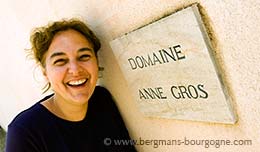


mmanuel Sainson from Volnay has come full circle. Almost. After relocating to the south of France, both to Corbières and to Rivesaltes, he is now back in his native Burgundy. With a domaine located in La Rochepot he now has a portfolio which spans from the Hautes-Côtes to the Beaujolais.
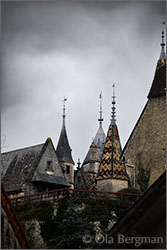
La Rochepot is up in the Hautes-Côtes, just a ten minute drive from Chassagne-Montrachet. Perhaps best-known for its fairytale-like castle, the Château de la Rochepot, the village counts 290 inhabitants and a handful of domaines.
Domaine Emmanuel Sainson is not only different in how the vineyards are distributed geographically. It is a 100 kilometre drive from La Rochepot and the Hautes-Côtes down to Juliénas and the Beaujolais. But also, when it comes to grape varieties there is of course the usual suspects such as pinot noir, gamay and chardonnay, but there is also viognier, gamaret and roussanne.
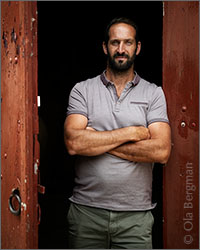
 – The domaine was created in July 2023, explains Emmanuel Sainson. I grew up in Volnay. My mother is a Rossignol, so I’m related to Nicolas Rossignol. His grandfather and my great-grandfather were brothers. My mother had eight hectares of vineyards in Beaune, Pommard, Volnay. I worked with my parents from 2002 and stopped in 2008 when they divorced.
– The family domaine still exists. But my mother doesn’t bottle anymore. She sells everything as grapes to négociants. Around the time when I left my parents I took on small plots of vineyards here and there, just for fun. I did 2500-3000 bottles a year and I also set up a company for ploughing with horses.
 – In 2011 our son was born and his mother fell very ill. So we had to move somewhere where it was warm and dry. Decided to leave Burgundy for Corbieres in order to to provide the best possible care there. I worked as chef de culture, vineyard manager, for a family domaine of 30 ha for three years, before I changed to a smaller domaine in Rivesaltes.
Emmanuel Sainson divorced in 2017 and decided to return to Burgundy. In January the following year he became chef de culture at Château de Pommard.
– In 2020 and 2021 I began looking for vineyards, because I really wanted to make my own wine. I was looking all over the place. Jura, Côte du Rhône… Here in Burgundy it is almost impossible to find anything. If you do, you need an investor to back you. I went down to the Beaujolais and found myself in Juliénas. I liked the place and as it happened I bumped into the guy whose vineyards I now rent. He was about to retire in two years time. We didn’t have any more contact, but one day I found a couple of ads on Facebook for vineyards. One of them turned out to be the same guy.
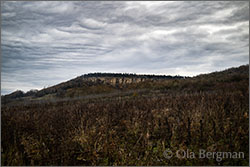 Originally the plan was to take on four and a half hectare in Juliénas, but things turned out differently and Emmanuel Sainson ended up taking on the whole domaine. Today he doesn’t think it was the best of decisions. 15 hectares in Juliénas simply turned out to be too much work. Especially with three difficult years in a row – 2023, 2024 and 2025. The vineyards are difficult to work, they are steep and the vines are very old. So he has decided to downsize and get rid of eleven and a half hectare. Nine hectares in total is a much more manageable size. He will try to stay this size, unless his mother one days asks him to take on a couple of vineyards in Volnay.
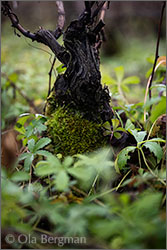 The viognier of the domaine is a Vin de France, the lowest level in the French wine classification system. It comes from a vineyard in Pruzilly.
– Pruzilly is in the Mâconnais, says Emmanuel Sainson. It is immediately north of Juliénas. It is a small commune. If you plant gamay the wine will be a Beaujolais-Villages. If you plant chardonnay it is Mâcon. I didn’t plant the viognier. It is a vineyard I have taken on. It makes a good wine, but in terms of maturity it is difficult. It is always like that there. You have to wait, but when you do that you have the birds, and then the wild boars, who like to eat the grapes. The winegrower at the time wanted to stand out a bit. He wanted to have something more than gamay. He planted chardonnay and viognier in order to have a slightly different portfolio to offer his clients.
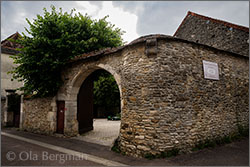 – The vines are young, just ten years old. This viognier is totally atypical compared with what you find in Condrieu or elsewhere in the Rhône valley. It is tighter, has more freshness and less of citrus character. It is not very different working with the viognier. Just more shoots. You have to be there all the time removing them, which can be a pain.
The Bourgogne Chardonnay brings together Burgundy and Beaujolais. It is a blend from three plots, two in Juliénas and one in Meursault
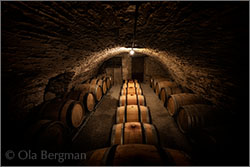
 – In Juliénas vineyards with chardonnay the terroir is pierre bleue, blue diorite. It’s 400 million years old. It’s the origin of the Massif Central. Produces a wine which is more spicy, more crisp. One was planted in 2015, the other in 1890. The latter is francs de pied, ungrafted vines, and it only produces three cases of grapes per year. The plot in Meursault, which I planted in 2006, is below the village. Since 2023 I’m using amphorae for the élevage. Nine months for the Bourgogne Chardonnay.
Amphorae are also used for the reds from the Beaujolais. This goes for the two crus, the Juliénas and the Chénas, as well as for the three cuvées of Vin de France.
– Manuia is a cuvée made from all the young vines in Juliénas, he says. Manuia is Tahitian for cheers. It’s a nod to my in-laws and my partner. 19 months élevage in tank. These vineyards are 50 per cent pink granite and 50 per cent blue diorite. The vines are around 20 years old and I use 50 per cent whole bunches. The blue diorite gives the spiciness and the pink granite roundness and freshness. The pink granite is what makes up 95% of the Beaujolais.
 In Chénas he has two hectares of vines, in the lieu-dit En Rémont. 100 per cent pink granite. For this wine the grapes are 100 per cent de-stemmed.
– The Juliénas, from the lieu-dit Haute Combe, is the big brother the Manuia. It is exactly the same, but the average age of the vines is 50 years. The tannins are a bit tougher, but the age of the vines makes it more generous. Silky tannins and good aromatic complexity.
– Un Soir de Novembre is a cuvée for my son who was born on November 5 in 2021. It was a full moon. It comes from Les Violettes in Juliénas. This vineyard is ploughed by horse. It is not something I do in all vineyards, just where the horse can go. Many vineyards are too steep. It is a Vin de France and it is 100 per cent blue diorite. I use 100 per cent whole bunches.
 The Mille Neuf Cent Quarante Neuf (1949 ) cuvée, a Vin de France as well, takes its name from
the average age of the vines. It is one parcel which covers two hectares, but the exposure is a bit odd. Straight north, straight east and northeast. In terms of soil there is pink granite, blue diorite and clay.
– For the élevage I prefer amphorae for the gamay wines and barrels for pinot, says Emmanuel Sainson. When it comes to oxidation amphorae do the exact same things as barrels, but without the oaky side. The viogner is done the Burgundian way in barrels, old barrels that have been used for four wines. Thanks to that they don’t become too oaky. For the roussanne it is the same thing.
In Burgundy, where the vineyards are not as steep, all the ploughing is done by horse. Apart from the already mentioned vineyard below Meursault Domaine Emmanuel Sainson also has vineyards in the Coteaux Bourguignons and Hautes-Côtes de Beaune appellations. The Coteaux Bourguignons vineyard recently joined the centenarian club.
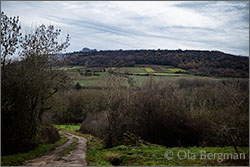 – It is mainly gamay, says Emmanuel Sainson, with a little bit of pinot noir. It was planted by an old grandpa in La Rochepot in 1925. Take the road towards Nolay and it is to the left just after the old garage in La Rochepot. It is the only vineyard out in the middle of a field. It was sold in 2024 when the old man died. A grower in La Rochepot bought for his son, but the son was not interested since he already had 28 hectares.
So when the 26 ares were put on the market again Emmanuel Sainson picked them up.
– The vineyard is badly placed. Since it is in the middle of the field you must have permission from the farmer who owns it to use his land to transport your horse and equipment. But since he is a friend of mine it worked out.
The Hautes–Côtes de Beaune vineyards, 1.10 hectare in total, are a little bit further away. Just a five-ten minute drive from La Rochepot.
– They are in the commune of Cormot, close to Nolay. One side of the road is Nolay, one is Cormot. Below the Viaduc de Cormot. The vines are 60 years old. There is clay-limestone soil, but is very chalky and sandy. The soil is light andwell-drained. It is not very steep. It is basically a large square. 1.10 hectare in one place. We have taken on another plot where we will plant chardonnay for Hautes-Côtes blanc. Bothe the Coteaux Bourguignons and the Hautes-Côtes de Beaune are 200 per cent de-stemmed.
© 2026 Ola Bergman